As you have fun with different piano chord progressions, one that is easy and yet conducive to achieving some interesting sounds on those keys is shown here:
I-II-III-II-I
We are looking at the first three diatonic chords of a key. Let’s use the key of C Major for our purposes here. In this case, we will be playing:
Cmaj7 – Dmin7 – Emin7 – Dmin7 – Cmaj7
So, we are climbing up to that III chord and back down to the I chord in a stepwise fashion. Now, this is one of those piano chord progressions that you can have a lot of fun improvising with. Actually, if you’re sitting in the corner of a restaurant or club with the lights dim and want to compliment the ambience with something delicate and tasteful, you can really make this sound like something.
The chords in their basic root positions are:
Cmaj7 = C E G B
Dmin7 = D F A C
Emin7 = E G B D
However, let’s apply that 1-7-3-5 piano chord voicing to this progression. So, what we will be playing is as follows:
(The Root and 7 of each of these chords are played with the left hand and the 3 and 5 are played with the right hand. Begin with the C below middle C as the first root and simply climb up in steps)
C B – E G (Cmaj7)
D C – F A (Dmin7)
E D – E G (Emin7)
Begin by playing up and down as you play all the chord tones of each chord at the same time. Then play the 1 and 7 of each chord together while you play the corresponding 3 and 5 in a melodic fashion, playing each note separately. As you do this and become more and more comfortable with it, you’ll begin to see that you can really get a nice cocktail piano sound climbing up and down this progression.
Play through this progression delicately and, as you do so, create some simple improvised melodies with the 3 and 5 of each chord. You’ll become more creative with this. Also, consider playing everything up one octave. Then come back down to the original octave. Then play the voicings in a “rolled” fashion, playing from the bottom chord tone (Root) to the top (5th), too!
Naturally, this chord voicing structure works well in your tunes. However, just using it as you play through this progression really lends itself to complimenting a quiet setting. In addition, just by playing these three chords, you can explore your potential improvising with just these few notes. Experiment with your dynamics as well, using crescendos and decrescendos.
As you really set the scene with this simple yet great sounding combination of chords, remember…
Always…
ALWAYS…
PLAY WITH PASSION!
Musically,
Dave
www.PianoAmore.net
www.ProProach.com
 If you are just beginning to learn jazz piano chords and have a decent familiarization with 7th chords, it will likely serve you well to begin harmonizing some of those tunes you are familiar with in a fashion that is both easy and conducive to getting a decent sound out of those keys.
 What exactly are cocktail piano chords? Well, as we have acknowledged, cocktail piano in itself is
  A piano improvisation handbook for beginners that will serve as a starting point for those who feel as though they would like some encouragement in this area is available. This guidebook is brief and is accompanied by a short video that demonstrates the easy approach presented. If you have felt inspired to improvise on piano but wish you had an easy way to get your feet wet, you are likely to find this one quite eye-opening (and ear-opening).
 If you have an interest in developing some pentatonic scale solos, as a beginner this is a good choice since you can really come up with some impressive sounds with little effort. Who said it needed to be complex to be good, right? It certainly doesn’t. Actually, when it comes to creating simplistic solos that sound “pro,” the utilization of pentatonic scales is an excellent choice.
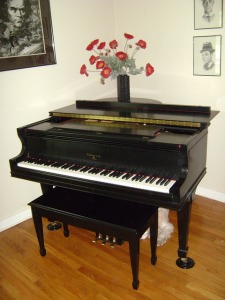 You want to play cocktail piano and wonder if you have what it takes. It’s been a specialty of mine for many years and I am happy to admit that I’ve had a lot of fun on each and every cocktail piano gig that I ever had to privilege of being a part of. I have played on board cruises, have performed for wedding receptions and for special corporate functions, and have served as a soloist for many other situations. As a cocktail pianist, you accept the responsibility of being the sole performer, so it’s all you! Along with this goes the kind of freedom that only a solo gig can provide.
 Would you like to know how to learn piano fast? What’s fast to you may be different to another, of course. Also, what would you like to be playing on those keys within a short amount of time? What your goals are and how devoted you are to learning will absolutely have an impact on what you will accomplish.