
 One jazz chord voicing you’ve just got to know as a cocktail piano player involves taking a simply 7th chord and making one simply modification to it. Specifically, I am referring to the 1-5-7-3 chord voicing.
Here’s how to play it…
Let’s use an Fmaj7 chord to illustrate. This chord in its most basic form is spelled out like this:
F A C E
Again, this is a 7th chord in root position. In addition, as you take a look at the chord tones, they are as close to each other as they can possibly be. In other words, there are no chord tone in between those chord tones that are already there. Therefore, this chord is said to be in closed position.
Okay, let’s take that 3rd of the chord, which is the A. If we don’t play that A where it is within the structure and, instead, play it one octave higher, the order of our chord tones from left to right looks like this:
F C E A
This is a very commonly used jazz chord voicing and one you’ll definitely want to have a handle on. You’ll want to apply this 1-5-7-3 structure to all the 7th chords that you learn eventually. Doing so will really add dimension to your playing!
Now, go ahead and play those two lower chord tones (the F and C) with your left hand and play the two upper chord tones (the E and A) with your right hand. Listen!
It sounds more “open,” would you agree? Actually, we call this an “open voicing” because we have actually opened up the chord by taking one of the inner chord tones and moving up an octave. You see, we really do have a chord tone that is not being played in between two of the other chord tones at this point (in between the F and C, there is that A which is not being played).
If you were playing a song in which the melody note was A and the chord was Fmaj7, this is a very appropriate jazz chord voicing to play since the A is at the top of the structure (furthest to the right). You are highly encouraged to apply this 1-5-7-3 to other 7th chords that you either already know or will learn in the future. It will work for all of them and, by doing so, you’ll really be adding to that “piano playing toolbox” of yours.
This is a jazz chord voicing you’ll want play again and again. Look for opportunities to use it in your favorite songs. Simply look for melody notes that are the 3rd of the 7th chord that you will be playing and use this voicing to turn what would otherwise be and “okay” sound into one that spells professionalism in the ears of your listeners!
Remember,
Always…
ALWAYS…
PLAY WITH PASSION!
Musically,
Dave
www.PianoAmore.net
www.ProProach.com
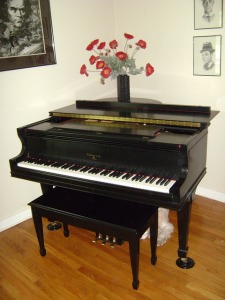 You want to play cocktail piano and wonder if you have what it takes. It’s been a specialty of mine for many years and I am happy to admit that I’ve had a lot of fun on each and every cocktail piano gig that I ever had to privilege of being a part of. I have played on board cruises, have performed for wedding receptions and for special corporate functions, and have served as a soloist for many other situations. As a cocktail pianist, you accept the responsibility of being the sole performer, so it’s all you! Along with this goes the kind of freedom that only a solo gig can provide.
 Would you like to know how to learn piano fast? What’s fast to you may be different to another, of course. Also, what would you like to be playing on those keys within a short amount of time? What your goals are and how devoted you are to learning will absolutely have an impact on what you will accomplish.
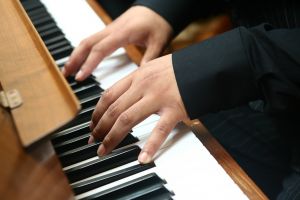 “I want to learn piano chords quickly” is a common request and understandably so. There is a certain kind of satisfaction that a beginning player can gain by learning to play even just a few chords on the piano. What’s more is that if they can be played in a confident manner, that confidence is instantly conveyed to the listener.