
.Jazz Piano Chord Voicings Program
 I would like to express my heartfelt thanks to the many recent positive comments I have been receiving from participants of this popular jazz piano chord voicings program. I often reflect on the moments of creation of ProProach and, whenever I do, I experience great feelings, as the energy that went into it was a manifestation of a desire to convey to others a simple, step-by-step procedure for others to enjoy many of the “tricks of the trade” in a fashion that was not only easy to understand but easy to implement. I’m so happy to continue to be able to report that people worldwide are enjoying its benefits.
Make The Most Each Lesson
Another thing I would like to express gratitude for is the devotion to those who have subscribed to the concept of learning and digesting one lesson at a time. Yes, I do completely understand the initial inclination to want to have all the lessons at once. Due to popular request, I have made the program available this way. That said, let me just mention that people who take advantage of this chord voicings program and use it in the manner in which it was originally intended are realizing the true value of following along this way.
I have a suggestion to those who have yet to enroll in ProProach. You will gain more value by taking yourself through the program again… and again. Individuals who follow through with 25 lessons more than once always experience benefits well beyond those gained from just one time. This continues to be confirmed by actual members who do so.
To those considering enrolling in the program, I would like to offer the suggestion that you use Lesson #1 and Lesson #2 in conjunction with each other. They are very much related. Spend at least a week with these lessons and apply them to the various keys (Cmaj9, Fmaj9, Bbmaj9, Dmin9, Gmin9, Amin9, etc). The satisfaction gained by doing so is huge, not to mention the confidence that you’ll begin to enjoy.
Stay Curious When Learning Jazz Piano Chord Voicings
In addition, I would encourage you to enjoy these lessons with an attitude of curiosity. Have fun with them as a child might have fun with a set of finger paints. The many “colors” that you are capable of creating are unlimited. As you continue to experience one lesson after another, you’ll see this for yourself. Furthermore, if you decide to get involved in Pro Piano Chord Bytes , you’ll experience something rather unique, as the two programs will enhance your piano chord voicing creative skills. ProProach does include a complimentary video with each lesson. For reasons aligned with taking personal creative initiative, Pro Piano Chord Bytes does not. Enroll and implement the strategies of both programs with enthusiasm and curiosity. Your results will be nothing short of astounding.
 When it comes to playing cocktail piano chords that are the among the easiest to play while being extremely effective, what we’ll be looking at here will rate high on the list. If you know how to play some simple triads (three-note chords), this will come easy to you. In addition, you’ll discover for yourself that, even if you don’t have a specific tune in mind, you can compliment a nice ambience with these cocktail piano chords when played subtlety and legato.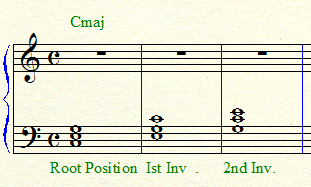


 Our focus on cocktail piano chords has included some attention on open chord voicings. As a review, let’s consider one way we can open up a chord like a Major 7th. We’ll use Fmaj7 for our example. This chord, in its most basic form (root position) is spelled like this:
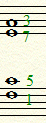 Play this chord voicing as it illustrated above and listen. Just the way it is here, we have one of the most popular cocktail piano chords played by the pros. You’ll notice that the chord has all four of the basic chord tones, so it is complete as it is. That said, let’s make it a little “fuller” by doubling the root and playing it in between the 3 and 7. We will leave the 1 and 5 “open”. Our result looks like this:
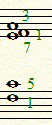 Play this new chord voicing as we have illustrated it and listen. Then compare the one preceding it by playing them both back and forth. It’s interesting how making one simple modification can change the texture of the voicing we are playing.

 When it comes to cocktail piano chords that you’ll use often, this one must be mentioned. It is one of the easiest to understand. That said, if your left hand is not used to playing 10th intervals, it may take a little getting used to. However, any effort put into this is well worth it.
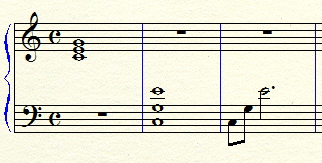 In the second measure above, you will see that we are playing the C and G of this chord one octave lower. The E is played where it was originally on the piano keyboard (it’s just written in bass clef to be consistent with the lower two chord tones and to put everything in the context of the left hand). So, you see, we have taken the middle note (in this case, the E) and moved it an octave higher. This is often referred to as “opening up the chord.” The distance now between the C and E is now a 10th interval instead of a 3rd interval.
 The drop 3 voicing is one of those piano chords that can be endlessly explored… and well worth the time and effort, too! Adding this concept to your cocktail piano playing will most surely add more interest to those standard songs.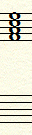
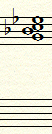 Okay, let’s turn this into a drop 3. Again, we will take that 3rd note from the top (in this case, the Bb) and move it one octave below:
 Again, compare the original structure with this drop 3 voicing. Learn to really appreciate the differences in sound achieved by even little variations like this. You’ve got a whole world of sound to explore!
 Here we will illustrate one of the most popular jazz piano chords of all time from the perspective of the pros. Yes, it’s another one of those “stock” voicings that you just have to be familiar with. Also, you’ll want to learn this one in all the keys. Not only will you want to but you’ll find it to be one of the easiest jazz piano voicings to execute as well
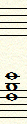 From bottom to top, we have F, B, E. In terms of scale degrees, these are the 7, 3, 13. Play this voicing and listen! Then play the G7 in its basic form above. Go back and forth and compare the sounds of the two. You’re likely to notice that the G13 voicing is quite contemporary in nature. This is due to the fact that it includes a tritone (F to B), a perfect fourth interval (B to E), and a Major 7th interval (F to E). So, there’s quite a bit of dissonance within this chord voicing! (Note that we do not use the 5 in this voicing)
 During one of lessons that focused on cocktail piano chords, we introduced the 1-7-3-5 chord voicing. We arrived at this voicing by simply starting out with a 7th chord in its basic root position like this:
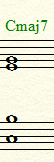 This is one of those cocktail piano chords that sounds great when climbing up the diatonic scale, as it sounds great over all the chord qualities, including but not limited to minor 7ths, dominant 7ths, diminished 7ths, and half-diminished chords.
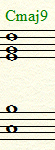 As the chord symbol states, we are now playing a 9th chord, specifically Cmaj9.
 Your exploration of cocktail piano chords must include the eventual understanding and implementation of diatonic 7th chords. In essence, within a given key, the diatonic system represents the “skeleton” of that key that you are playing in.
 The cocktail piano chords being presented here, when used sparingly and in the right places, really serve as a tasteful addition to your “piano playing toolbox” if you haven’t been using them already.
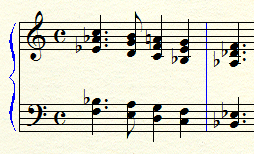 Okay, as we proceed with the melody, notice that we utilize the same exact construction below each melody note. So, again, from top to bottom, it’s:
 As you have fun with different piano chord progressions, one that is easy and yet conducive to achieving some interesting sounds on those keys is shown here: