

 When it comes to cocktail piano chords that you’ll use often, this one must be mentioned. It is one of the easiest to understand. That said, if your left hand is not used to playing 10th intervals, it may take a little getting used to. However, any effort put into this is well worth it.
We will use a simple triad (three-note chord) for this. Specifically, the chord here is C Major. In the first measure below, you will see this chord in its basic root position:
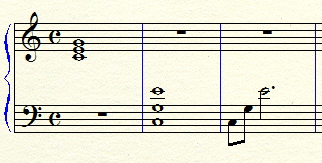 In the second measure above, you will see that we are playing the C and G of this chord one octave lower. The E is played where it was originally on the piano keyboard (it’s just written in bass clef to be consistent with the lower two chord tones and to put everything in the context of the left hand). So, you see, we have taken the middle note (in this case, the E) and moved it an octave higher. This is often referred to as “opening up the chord.” The distance now between the C and E is now a 10th interval instead of a 3rd interval.
Okay, now we will play these chord tones one at a time, as in the third measure. We are starting on the low C, proceeding to G (playing these as eighth notes), and then finally arriving at the E just above middle C, which can be held for the duration of the measure. Typically, the left hand fingers used are the pinky, index finger, and thumb, respectively. Now, if you have small hands, do not be concerned because you do not need to leave your pinky on the lowest note (the root) as you proceed to the other chord tones. The pedal will do the work of sustaining these, resulting in a very nice effect.
This is a left hand pattern that you will want to not only familiarize yourself with but it’s one of those cocktail piano chords (played a note at a time) that you will use again and again, so put some time into this one. Of course, you will want to become comfortable with playing this with the other triads as well.
I would like you to see this left hand accompaniment technique demonstrated. If you will simply visit here, you will see a video excerpt from the first in my Cocktail Piano 1-2-3 series. Right at the very beginning of that video, you will notice this left hand accompaniment being played using the C Major chord just as we have mentioned here. You will notice that it is being played in conjunction with a “root-chord” accompaniment, which results in some nice variety!
Remember,
Always…
ALWAYS…
PLAY WITH PASSION!
Musically,
Dave
www.PianoAmore.net
www.ProProach.com
 Time and time again, I have received emails from members of Piano Amore (www.PianoAmore.net) asking how someone at a beginner level can learn how to play cocktail piano from scratch, while having very little or no experience at all. I can’t tell you how much I appreciate those emails because when I read them, the enthusiasm of the person writing is always quite evident. So, if you’re one of those people who inquired, let me thank you because it’s people like you who inspire me to create ways of helping cocktail piano enthusiasts in any way I can.
 An exploration of cocktail piano chords really ought to include an eventual thorough understanding of chord inversions. Mastery of your inversions is most certainly conducive to increased confidence when it comes to adding some style to those favorite songs of yours.


 Your investigation of jazz piano chords would be well served by gaining a familiarity of drop 2 voicings. It’s one effective way to take what you already know to more creative levels for sure. As a cocktail piano player, you’ll absolutely learn to love this approach to voicing chords on the piano. Simply playing a couple of drop 2 voicings in succession results in your sounding like you know what you are doing at those keys.
 If you have an interest in developing some pentatonic scale solos, as a beginner this is a good choice since you can really come up with some impressive sounds with little effort. Who said it needed to be complex to be good, right? It certainly doesn’t. Actually, when it comes to creating simplistic solos that sound “pro,” the utilization of pentatonic scales is an excellent choice.
 This piano improvisation tutorial focuses on a very simple technique that you will love to love if the idea of improvising is new to you. It involves using chromaticism, or using half steps.
 One jazz chord voicing you’ve just got to know as a cocktail piano player involves taking a simply 7th chord and making one simply modification to it. Specifically, I am referring to the 1-5-7-3 chord voicing.
 You want to play cocktail piano and wonder if you have what it takes. It’s been a specialty of mine for many years and I am happy to admit that I’ve had a lot of fun on each and every cocktail piano gig that I ever had to privilege of being a part of. I have played on board cruises, have performed for wedding receptions and for special corporate functions, and have served as a soloist for many other situations. As a cocktail pianist, you accept the responsibility of being the sole performer, so it’s all you! Along with this goes the kind of freedom that only a solo gig can provide.
 Among the numerous piano improvisation tips I am able to share with you, if I was asked to share one that stands out above the crowd in terms of effectiveness, it would be this one:
 The exploration of jazz piano chords is an important part of your journey toward more creative cocktail piano playing. Of course, the benefits go beyond the scope of playing cocktail piano. In short, the more you learn about jazz piano chords, the more interesting your playing becomes from a harmonic standpoint.