
ProProach Piano Chord Voicings Program: What Makes It So Effective?
 Chord voicings is the name of the game with ProProach. Now, in this message, I would like to acknowledge a question received a number of times regarding how this popular piano chord program is presented. Here it is:
“Can I receive all the lessons in ProProach at one time?”
The perceived “benefit” of having all the lessons at one’s fingertips from the perspective of the person asking the question is understandable. It’s human nature to want to “browse” and “pick and choose” certain favorite chord voicings to play with and experience instantly.
Is there anything wrong with that? Of course not. However, it ought to be pointed out that much of the true effectiveness of ProProach can be credited to the gradual implementation of new voicings as they are learned. Actually, the very same individuals who ask the question above are the folks who, upon exposing themselves to the program, are kind enough to write me and let me know that it is this very approach to learning which is responsible for the gained confidence they enjoy as growing piano stylists.
That said, the truth is that you actually do get to have the entire collection of lessons and video demonstrations at your fingertips once you’ve taken yourself through the program. Time and time again, members have notified me that this has become especially invaluable to the even more so because they followed the program as suggested. The reason? Well, once ProProach has been enjoyed the way it’s been intended, going through the program offers a different perspective each time. Truly, this is a piano chord voicings program that you can grow with.
Even the very first lesson of the program (which is currently being offered for free on the main site) can be taken to many different levels. My video session in Cocktail Piano Secrets #1 helps one do just that. If you’d like to get a handle on a nice way to create some tasteful harmonic piano fills, that program is one I hope you will consider.
I am always happy to communicate with people who have taken the leap and taken advantage of this program, as the fun I had in creating it is matched only by the satisfaction I personally get when a ProProach member emails me with a message similar to the many testimonials you will find on the site. I am inspired by your progress!
Remember,
Always…
ALWAYS…
PLAY WITH PASSION!
Musically,
Dave
www.PianoAmore.net
www.ProProach.com
 When it comes to playing cocktail piano chords that are the among the easiest to play while being extremely effective, what we’ll be looking at here will rate high on the list. If you know how to play some simple triads (three-note chords), this will come easy to you. In addition, you’ll discover for yourself that, even if you don’t have a specific tune in mind, you can compliment a nice ambience with these cocktail piano chords when played subtlety and legato.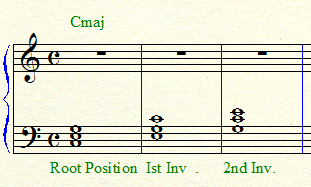


 Our focus on cocktail piano chords has included some attention on open chord voicings. As a review, let’s consider one way we can open up a chord like a Major 7th. We’ll use Fmaj7 for our example. This chord, in its most basic form (root position) is spelled like this:
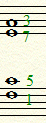 Play this chord voicing as it illustrated above and listen. Just the way it is here, we have one of the most popular cocktail piano chords played by the pros. You’ll notice that the chord has all four of the basic chord tones, so it is complete as it is. That said, let’s make it a little “fuller” by doubling the root and playing it in between the 3 and 7. We will leave the 1 and 5 “open”. Our result looks like this:
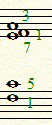 Play this new chord voicing as we have illustrated it and listen. Then compare the one preceding it by playing them both back and forth. It’s interesting how making one simple modification can change the texture of the voicing we are playing.
 Let’s take a look at a couple of jazz piano chords that, when played one after the other, make for one of the most popular endings of all time. We will relate this to the key of C Major for our illustration. Of course, as always, you are highly encouraged to transpose what you learn to other keys.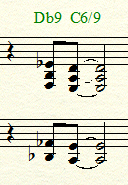
 One jazz chord voicing you’ve just got to know as a cocktail piano player involves taking a simply 7th chord and making one simply modification to it. Specifically, I am referring to the 1-5-7-3 chord voicing.