
 Any discussion of jazz piano chords much acknowledge this popular chord voicing among the pros. It’s a stock voicing that you’ve got to know. It’s another one of what we call rootless voicings. Many times when a min7 chord is called for, this is one that is used…
Let’s play a Dmin7 chord in its basic root position, which is spelled out like this:
D F A C
Now, if we related this chord to a corresponding scale, we see that the 1, 3, 5, and 7 comprise this chord:
D E F G A B C D E etc.
1 2 3 4 5 6 7 8 9 …
We have stretched a little beyond an octave to illustrate that, if we continue building in thirds beyond that 7 of the chord, the 9 is next in line. Well, lets add that to our original Dmin7 chord:
D F A C E
This results in a Dmin9 chord. To a jazz or cocktail pianist this is one of those jazz piano chords that is often played when the 7th chord is asked for. So, the music doesn’t have to call for a 9th in order to play it. It is often automatically considered for extra color.
Well, if we take away that root of the chord, what we have left is:
F A C E
So, we have the 3-5-7-9 chord voicing. Again, this is a rootless voicing. So, does that mean the root never gets played? Well, not exactly. If you are playing with a bass player, he or she will be playing that root. If you are playing solo piano, you can certainly play that root in the bass area before or after playing the voicing for added fullness. Perhaps the root in the bass area can be played on beat one and the voicing above can be played on beat 2 (or vice versa). Maybe each is played for 2 beats, which works nicely for ballads.
In addition, if you are playing as an accompanist for a singer or other instrumentalist, you might play that root in the bass area with the left hand while playing the voicing with the right.
This min9 voicing is one that you will want to learn in all the keys so that you can play it anytime on command. It’s a good idea to practice voicings around the circle of fifths. You can also play them chromatically up and down, raising each chord tone up or down a half step as you change keys, which makes it easier to find them.
As you play toward mastery over this popular voicing, remember…
Always…
ALWAYS…
PLAY WITH PASSION!
Musically,
Dave
www.PianoAmore.com
www.ProProach.com
 As our exploration of jazz piano chords continues, it’s a good time to acknowledge that tritone substitution principle that is so often used by the pros. There are variations on this concept but the most popular one is what we will be looking at here.
 Here we will illustrate one of the most popular jazz piano chords of all time from the perspective of the pros. Yes, it’s another one of those “stock” voicings that you just have to be familiar with. Also, you’ll want to learn this one in all the keys. Not only will you want to but you’ll find it to be one of the easiest jazz piano voicings to execute as well
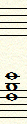 From bottom to top, we have F, B, E. In terms of scale degrees, these are the 7, 3, 13. Play this voicing and listen! Then play the G7 in its basic form above. Go back and forth and compare the sounds of the two. You’re likely to notice that the G13 voicing is quite contemporary in nature. This is due to the fact that it includes a tritone (F to B), a perfect fourth interval (B to E), and a Major 7th interval (F to E). So, there’s quite a bit of dissonance within this chord voicing! (Note that we do not use the 5 in this voicing)
 During one of lessons that focused on cocktail piano chords, we introduced the 1-7-3-5 chord voicing. We arrived at this voicing by simply starting out with a 7th chord in its basic root position like this:
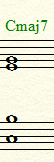 This is one of those cocktail piano chords that sounds great when climbing up the diatonic scale, as it sounds great over all the chord qualities, including but not limited to minor 7ths, dominant 7ths, diminished 7ths, and half-diminished chords.
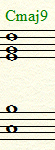 As the chord symbol states, we are now playing a 9th chord, specifically Cmaj9.
 The cocktail piano chords being presented here, when used sparingly and in the right places, really serve as a tasteful addition to your “piano playing toolbox” if you haven’t been using them already.
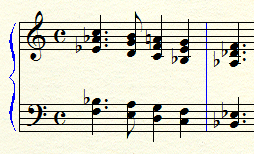 Okay, as we proceed with the melody, notice that we utilize the same exact construction below each melody note. So, again, from top to bottom, it’s:
 Your investigation of jazz piano chords would be well served by gaining a familiarity of drop 2 voicings. It’s one effective way to take what you already know to more creative levels for sure. As a cocktail piano player, you’ll absolutely learn to love this approach to voicing chords on the piano. Simply playing a couple of drop 2 voicings in succession results in your sounding like you know what you are doing at those keys.
 When it comes to jazz piano chords, less really can mean more when it comes to sound and texture. You probably already realize that it doesn’t take a lot of notes to create some really interesting harmony. Actually, this is very true. Let’s consider one example of this concept in action below.
 As you explore your world of cocktail piano chords and voicings, you will undoubtedly find yourself investigating open voicings if you haven’t already. In this message, I would like to suggest a concept that is so very easy to get a handle on yet is very effective at the same time.
 Let’s take a look at what can be referred to as a stock jazz chord voicing. We use the term “stock” since this is a voicing that virtually all jazz piano players will use. In other words, it’s “on the shelf” ready for use and it gets used often. This particular chord structure can be used for minor 7th chords.
 If you are just beginning to learn jazz piano chords and have a decent familiarization with 7th chords, it will likely serve you well to begin harmonizing some of those tunes you are familiar with in a fashion that is both easy and conducive to getting a decent sound out of those keys.