
 During one of lessons that focused on cocktail piano chords, we introduced the 1-7-3-5 chord voicing. We arrived at this voicing by simply starting out with a 7th chord in its basic root position like this:
Cmaj7 = C E G B
and then taking the two middle chord tones (the 3 and 5) and moving them an octave higher, resulting in this voicing:
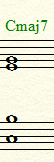 This is one of those cocktail piano chords that sounds great when climbing up the diatonic scale, as it sounds great over all the chord qualities, including but not limited to minor 7ths, dominant 7ths, diminished 7ths, and half-diminished chords.
Now, let’s take this jazz piano chord voicing a step further by adding the 9 at the top. Here is what this looks like when we apply it to the same chord (the Cmaj7):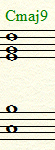 As the chord symbol states, we are now playing a 9th chord, specifically Cmaj9.
If you are playing a song that calls for a Cmaj7 chord and the melody happens to be the 9, how appropriate! However, take notice of the space between the 5 and 9 of this chord voicing. There are three notes being skipped (the 6, 7, and 1). When using this chord voicing, you have a nice compliment to any melody note that happens to be one of these tones as well.
Consider this: we have only applied this 1-7-3-5-9 chord voicing to a Major 7th chord. In addition to playing this voicing for the eleven other Major 7th chords, you will find great pleasure and satisfaction in applying this voicing formula to other chord qualities.
This chord voicing works great when you are accompanying a singer or instrumentalist, too, so you’ll want to keep this one at the top of that “piano playing toolbox” of yours for sure.
It’s interesting, too, that simply playing this voicing over a few chords really projects nicely when you are wanting to compliment a quiet ambience. Consider “rolling” them as well (playing the voicing one note at a time from bottom to top and/or top to bottom).
We acknowledge this chord voicing in ProProach as a beginning to a journey that’s full of musical goodies. We explore lots of interesting chord structures in that popular chord voicing program that is being enjoyed worldwide. A great feature of that program is that, once you get a handle on a particular chord voicing, you are shown how to actually apply it in your favorite tunes, which is really conducive to confidence!
Remember…
Always…
ALWAYS…
PLAY WITH PASSION!
Musically,
Dave
www.PianoAmore.net
www.ProProach.com
 The cocktail piano chords being presented here, when used sparingly and in the right places, really serve as a tasteful addition to your “piano playing toolbox” if you haven’t been using them already.
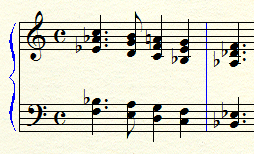 Okay, as we proceed with the melody, notice that we utilize the same exact construction below each melody note. So, again, from top to bottom, it’s:
 Your investigation of jazz piano chords would be well served by gaining a familiarity of drop 2 voicings. It’s one effective way to take what you already know to more creative levels for sure. As a cocktail piano player, you’ll absolutely learn to love this approach to voicing chords on the piano. Simply playing a couple of drop 2 voicings in succession results in your sounding like you know what you are doing at those keys.
 Let’s take a look at what can be referred to as a stock jazz chord voicing. We use the term “stock” since this is a voicing that virtually all jazz piano players will use. In other words, it’s “on the shelf” ready for use and it gets used often. This particular chord structure can be used for minor 7th chords.
 One jazz chord voicing you’ve just got to know as a cocktail piano player involves taking a simply 7th chord and making one simply modification to it. Specifically, I am referring to the 1-5-7-3 chord voicing.
 The exploration of jazz piano chords is an important part of your journey toward more creative cocktail piano playing. Of course, the benefits go beyond the scope of playing cocktail piano. In short, the more you learn about jazz piano chords, the more interesting your playing becomes from a harmonic standpoint.