 When it comes to playing cocktail piano chords that are the among the easiest to play while being extremely effective, what we’ll be looking at here will rate high on the list. If you know how to play some simple triads (three-note chords), this will come easy to you. In addition, you’ll discover for yourself that, even if you don’t have a specific tune in mind, you can compliment a nice ambience with these cocktail piano chords when played subtlety and legato.
Again, we’re using simple triads here. For our example, we will look at the C Major triad in Root Position, 1st Inversion, and 2nd Inversion in their closed postions:
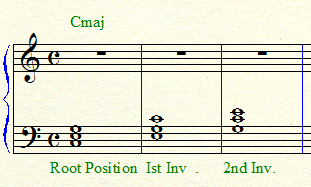
By simply opening up these triads and playing them in their open positions, we arrive at some very nice textures. When supported with the use of the sustain pedal, sometimes played as we see below and other times played in a arpeggiated fashion, you can easily grab a listener’s ear with very sparse playing…

If the concept of “opening” a chord is new to you, we are simply taking the middle chord tone of each position in our first illustration above and playing it one octave higher. Yes, two hands will be used, and this particular example that we just illustrated can be easily fingered with the right hand by simply fingering a Cmaj in 1st inversion (while allowing the left hand to take care of everything else). Doing so places your right hand fingers within easy grasp of E, G and C as they are played subsequently, as shown above.
Once you are comfortable with playing our example above in open positions, consider playing through a chord progression using these open positions. Doing so will accomplish at least two things: 1) Your confidence with playing triads in open positions will rise tremendously; 2) You’ll be playing something that sounds quite nice when taking those open positions through, say, a I – vii – ii – V chord progression like Cmaj – Amin – Dmin – Gmaj.
Please consider putting the above suggestion to use in addition to understanding it intellectually. Actually take yourself through the three positions over each chord in that chord progressions. You’ll automatically have, at your fingertips, twelve interesting chord textures you can feel good about adding to that “piano playing toolbox” of yours.
Next, take yourself through an entire favorite song of yours and simply play the chords in their open position inversions as if you were accompanying yourself while singing the melody. Experiment with different inversions as you play through the chord changes of the song again and again. Watch your confidence with playing cocktail piano chords grow!
Remember,
Always…
ALWAYS…
PLAY WITH PASSION!
Musically,
Dave
www.PianoAmore.net
www.ProProach.com

 When it comes to cocktail piano chords that you’ll use often, this one must be mentioned. It is one of the easiest to understand. That said, if your left hand is not used to playing 10th intervals, it may take a little getting used to. However, any effort put into this is well worth it.
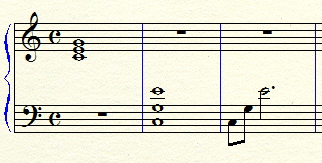 In the second measure above, you will see that we are playing the C and G of this chord one octave lower. The E is played where it was originally on the piano keyboard (it’s just written in bass clef to be consistent with the lower two chord tones and to put everything in the context of the left hand). So, you see, we have taken the middle note (in this case, the E) and moved it an octave higher. This is often referred to as “opening up the chord.” The distance now between the C and E is now a 10th interval instead of a 3rd interval.
 Time and time again, I have received emails from members of Piano Amore (www.PianoAmore.net) asking how someone at a beginner level can learn how to play cocktail piano from scratch, while having very little or no experience at all. I can’t tell you how much I appreciate those emails because when I read them, the enthusiasm of the person writing is always quite evident. So, if you’re one of those people who inquired, let me thank you because it’s people like you who inspire me to create ways of helping cocktail piano enthusiasts in any way I can.
 The drop 3 voicing is one of those piano chords that can be endlessly explored… and well worth the time and effort, too! Adding this concept to your cocktail piano playing will most surely add more interest to those standard songs.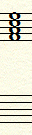
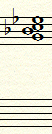 Okay, let’s turn this into a drop 3. Again, we will take that 3rd note from the top (in this case, the Bb) and move it one octave below:
 Again, compare the original structure with this drop 3 voicing. Learn to really appreciate the differences in sound achieved by even little variations like this. You’ve got a whole world of sound to explore!
 Your exploration of cocktail piano chords must include the eventual understanding and implementation of diatonic 7th chords. In essence, within a given key, the diatonic system represents the “skeleton” of that key that you are playing in.
 If you are just beginning to learn jazz piano chords and have a decent familiarization with 7th chords, it will likely serve you well to begin harmonizing some of those tunes you are familiar with in a fashion that is both easy and conducive to getting a decent sound out of those keys.
 You want to play cocktail piano and wonder if you have what it takes. It’s been a specialty of mine for many years and I am happy to admit that I’ve had a lot of fun on each and every cocktail piano gig that I ever had to privilege of being a part of. I have played on board cruises, have performed for wedding receptions and for special corporate functions, and have served as a soloist for many other situations. As a cocktail pianist, you accept the responsibility of being the sole performer, so it’s all you! Along with this goes the kind of freedom that only a solo gig can provide.
 The exploration of jazz piano chords is an important part of your journey toward more creative cocktail piano playing. Of course, the benefits go beyond the scope of playing cocktail piano. In short, the more you learn about jazz piano chords, the more interesting your playing becomes from a harmonic standpoint.