
 During our last lesson that focused on jazz piano chords, we took a look at a very popular way to voice that II-V chord progression among the pros. It’s interesting to note that this II-V chord progression is the most common chord progression in all of jazz and pop harmony. Well, let’s take a look at an extension of this progression…
The II-V chord progression often resolves to the I chord of the key. Actually, you might even say that these three chords played in succession define the key that you are in. Let’s explore the diatonic 7th chords in the key of C Major:
The II chord is Dmin7
The V chord is G7
The I chord is Cmaj7
This is how we voiced the II-V chord progression in our last lesson:
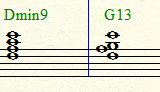
Before we resolve this progression to the Imaj7 chord, let’s take a look at the spelling of the Cmaj7 chord in its basic form:
C E G B
In relation to the corresponding C Major scale, these chord tones represent the 1, 3, 5, and 7, respectively.
C D E F G A B C D etc…
1 2 3 4 5 6 7 8 9 etc…
Above, we can see that, if we extend the scale beyond an octave and continue building in thirds, we arrive at the 9 (which is the same letter name as the 2):
C E G B D
Now, remaining consistent with our progression of rootless voicings, we can create a Cmaj9 chord voicing by playing the upper four tones, which are E, G, B, and D. Looking at our illustration below, we can see (and hear) how nicely this progression resolves with smooth voice leading using this voicing:

Within this II-V-I chord progression, we have three of the most commonly played jazz piano chords or voicings played among the pros. If you make it a point to eventually learn these voicings in all the keys, imagine the confidence you will have gained with three of the most important chord qualities in music!
It would be a good time to browse through some of those favorite standard songs of yours and see how often you see both the II-V and II-V-I chord progressions occur. The very doing of this will increase your awareness of songs are put together since, again, it is the most often used progression that exists, especially in jazz standards.
You are on your way to really enhancing your understanding of music. In addition, as you actually commit to playing these examples in different keys, your cocktail piano playing confidence will soar like it never did before!
Remember,
Always…
ALWAYS…
PLAY WITH PASSION!
Musically,
Dave
www.PianoAmore.net
www.ProProach.com
 As our fun with jazz piano chords continues, here we will make reference to a previous lesson that focused on turning a minor 7th chord into a minor 9th chord. Specifically, we will use the same Dmin9 chord voicing for our purpose.
  These are two of the most popularly played jazz piano chords of all time. Again, it’s that one little “switch” that turns the Dmin9 into a G13 chord.
 When it comes to playing cocktail piano, of the many piano improvisation tips I could offer, a favorite to promote that is most conducive to getting satisfying results is using chord tones. However, this approach can take on a more mature flair when your mind set is that of combining chord tones with thinking and playing in a linear fashion as well.
 As you have fun with different piano chord progressions, one that is easy and yet conducive to achieving some interesting sounds on those keys is shown here: