

 When you hear the same tune being played by a number of different players, it’s pretty easy to determine which of those players have a real handle on what they are doing in terms of harmony. It doesn’t take much effort to recognize when great sounding piano chords are being played.
But what do we mean by great sounding piano chords?
Some beginning players who have a handle on those basic chords, including triads and 7th chords, might be thinking, “But I learned all these chords. If I know them all, isn’t this all there is to know?” Often, it’s these same individuals who will put on a recording of a pianist like Bill Evans and, after listening to just a few measures of a song they are familiar with, will admit that there’s some kind of “magic” going on that they can’t seem to put their finger on.
So, what’s the secret to playing great sounding piano chords?
Voicings.
That’s right. An understanding of piano voicings is what “separates the men from the boys” when it comes to piano styling. It’s one thing to know what a G7 chord is and playing it is not really a challenge. But when you play it in the basic manner that most initially learn it, that “magic” doesn’t seem to manifest.
However, an understanding of the many ways that G7 chord can be voiced leads you down a different road – a path worth exploring. The good news is you don’t have to know everything about piano voicings to gain benefit from them. Actually, you can start enjoying benefits as soon as you learn one or two and decide to implement them by incorporating them in your favorite songs.
Two programs that are highly recommended (if you truly want to start having fun with piano voicings) are ProProach and Pro Piano Chord Bytes. The first is a 24-week program in which a new lesson is sent to your email box each week. Basically how this works is you learn one new voicing and use it to the point of being confident with it in the context of your favorite songs… then you learn a new one, and the process of development continues. Once you accumulate all the lessons, you can continue enjoying them indefinitely. Actually, some of the major benefits gained are reported from users of ProProach who have taken themselves through the program more than once (this one’s unique, folks). The lessons consist of textual explanations and videos that support the content. A great feature of this one is that you not only learn how to play those special chord sounds of the pros but you also learn how to apply them in your favorite tunes.
Pro Piano Chord Bytes is another weekly program that is also delivered to your email box. This one does not consist of videos. Rather it provides you with one approach to voicing a chord per week and also consist of commentary that leads you to think for yourself so that you are encouraged to create your very own chord voicings.
What happens when you combine these programs as part of a “balanced diet of musical nutrition?” In short, your confidence when it comes to playing those “chord sounds of the pros” soars like never before.
Get involved with making an exploration of piano voicings an important part of your musical journey and you’ll soon wonder where the time has gone and why you didn’t know this stuff before. But don’t fret. There’s no time like the present. Give yourself the opportunity to explore your musical potential with piano voicings and remember…
Always…
ALWAYS…
PLAY WITH PASSION!
Musically,
Dave
www.PianoAmore.net
www.ProProach.com

 Our focus on cocktail piano chords has included some attention on open chord voicings. As a review, let’s consider one way we can open up a chord like a Major 7th. We’ll use Fmaj7 for our example. This chord, in its most basic form (root position) is spelled like this:
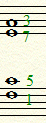 Play this chord voicing as it illustrated above and listen. Just the way it is here, we have one of the most popular cocktail piano chords played by the pros. You’ll notice that the chord has all four of the basic chord tones, so it is complete as it is. That said, let’s make it a little “fuller” by doubling the root and playing it in between the 3 and 7. We will leave the 1 and 5 “open”. Our result looks like this:
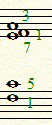 Play this new chord voicing as we have illustrated it and listen. Then compare the one preceding it by playing them both back and forth. It’s interesting how making one simple modification can change the texture of the voicing we are playing.

 When it comes to cocktail piano chords that you’ll use often, this one must be mentioned. It is one of the easiest to understand. That said, if your left hand is not used to playing 10th intervals, it may take a little getting used to. However, any effort put into this is well worth it.
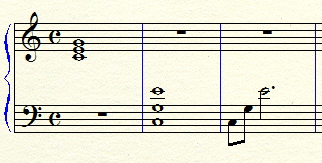 In the second measure above, you will see that we are playing the C and G of this chord one octave lower. The E is played where it was originally on the piano keyboard (it’s just written in bass clef to be consistent with the lower two chord tones and to put everything in the context of the left hand). So, you see, we have taken the middle note (in this case, the E) and moved it an octave higher. This is often referred to as “opening up the chord.” The distance now between the C and E is now a 10th interval instead of a 3rd interval.
 Time and time again, I have received emails from members of Piano Amore (www.PianoAmore.net) asking how someone at a beginner level can learn how to play cocktail piano from scratch, while having very little or no experience at all. I can’t tell you how much I appreciate those emails because when I read them, the enthusiasm of the person writing is always quite evident. So, if you’re one of those people who inquired, let me thank you because it’s people like you who inspire me to create ways of helping cocktail piano enthusiasts in any way I can.
 The drop 3 voicing is one of those piano chords that can be endlessly explored… and well worth the time and effort, too! Adding this concept to your cocktail piano playing will most surely add more interest to those standard songs.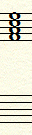
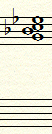 Okay, let’s turn this into a drop 3. Again, we will take that 3rd note from the top (in this case, the Bb) and move it one octave below:
 Again, compare the original structure with this drop 3 voicing. Learn to really appreciate the differences in sound achieved by even little variations like this. You’ve got a whole world of sound to explore!
 An exploration of cocktail piano chords really ought to include an eventual thorough understanding of chord inversions. Mastery of your inversions is most certainly conducive to increased confidence when it comes to adding some style to those favorite songs of yours.


 During our last lesson that focused on jazz piano chords, we took a look at a very popular way to voice that II-V chord progression among the pros. It’s interesting to note that this II-V chord progression is the most common chord progression in all of jazz and pop harmony. Well, let’s take a look at an extension of this progression…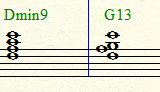

 As our fun with jazz piano chords continues, here we will make reference to a previous lesson that focused on turning a minor 7th chord into a minor 9th chord. Specifically, we will use the same Dmin9 chord voicing for our purpose.
  These are two of the most popularly played jazz piano chords of all time. Again, it’s that one little “switch” that turns the Dmin9 into a G13 chord.
 Let’s take a look at a couple of jazz piano chords that, when played one after the other, make for one of the most popular endings of all time. We will relate this to the key of C Major for our illustration. Of course, as always, you are highly encouraged to transpose what you learn to other keys.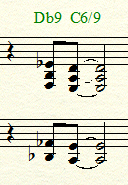
 Any discussion of jazz piano chords much acknowledge this popular chord voicing among the pros. It’s a stock voicing that you’ve got to know. It’s another one of what we call rootless voicings. Many times when a min7 chord is called for, this is one that is used…