
.Jazz Piano Chord Voicings Program
 I would like to express my heartfelt thanks to the many recent positive comments I have been receiving from participants of this popular jazz piano chord voicings program. I often reflect on the moments of creation of ProProach and, whenever I do, I experience great feelings, as the energy that went into it was a manifestation of a desire to convey to others a simple, step-by-step procedure for others to enjoy many of the “tricks of the trade” in a fashion that was not only easy to understand but easy to implement. I’m so happy to continue to be able to report that people worldwide are enjoying its benefits.
Make The Most Each Lesson
Another thing I would like to express gratitude for is the devotion to those who have subscribed to the concept of learning and digesting one lesson at a time. Yes, I do completely understand the initial inclination to want to have all the lessons at once. Due to popular request, I have made the program available this way. That said, let me just mention that people who take advantage of this chord voicings program and use it in the manner in which it was originally intended are realizing the true value of following along this way.
I have a suggestion to those who have yet to enroll in ProProach. You will gain more value by taking yourself through the program again… and again. Individuals who follow through with 25 lessons more than once always experience benefits well beyond those gained from just one time. This continues to be confirmed by actual members who do so.
To those considering enrolling in the program, I would like to offer the suggestion that you use Lesson #1 and Lesson #2 in conjunction with each other. They are very much related. Spend at least a week with these lessons and apply them to the various keys (Cmaj9, Fmaj9, Bbmaj9, Dmin9, Gmin9, Amin9, etc). The satisfaction gained by doing so is huge, not to mention the confidence that you’ll begin to enjoy.
Stay Curious When Learning Jazz Piano Chord Voicings
In addition, I would encourage you to enjoy these lessons with an attitude of curiosity. Have fun with them as a child might have fun with a set of finger paints. The many “colors” that you are capable of creating are unlimited. As you continue to experience one lesson after another, you’ll see this for yourself. Furthermore, if you decide to get involved in Pro Piano Chord Bytes , you’ll experience something rather unique, as the two programs will enhance your piano chord voicing creative skills. ProProach does include a complimentary video with each lesson. For reasons aligned with taking personal creative initiative, Pro Piano Chord Bytes does not. Enroll and implement the strategies of both programs with enthusiasm and curiosity. Your results will be nothing short of astounding.

 When you hear the same tune being played by a number of different players, it’s pretty easy to determine which of those players have a real handle on what they are doing in terms of harmony. It doesn’t take much effort to recognize when great sounding piano chords are being played.
 Your repertoire of jazz piano chords will undoubtedly include the exploration of quartal voicings if you are sincere in your interest in this art form. There is much to share when it comes to quartal voicings and we do acknowledge them in
 Our journey with jazz piano chords continues as we take a look at upper structure triads. There are several of these and, here, will take a look at one.
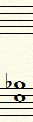 We mentioned that the b9 and 13 will be added. Although we can identify the b9 as the Db and the 13 as the A with some thought, playing this chord becomes “easy as pie” when we think in terms of a triad. Think “A major” and play it over that 3 and 7, which looks like this:
 The drop 3 voicing is one of those piano chords that can be endlessly explored… and well worth the time and effort, too! Adding this concept to your cocktail piano playing will most surely add more interest to those standard songs.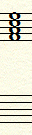
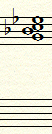 Okay, let’s turn this into a drop 3. Again, we will take that 3rd note from the top (in this case, the Bb) and move it one octave below:
 Again, compare the original structure with this drop 3 voicing. Learn to really appreciate the differences in sound achieved by even little variations like this. You’ve got a whole world of sound to explore!
 During our last lesson that focused on jazz piano chords, we took a look at a very popular way to voice that II-V chord progression among the pros. It’s interesting to note that this II-V chord progression is the most common chord progression in all of jazz and pop harmony. Well, let’s take a look at an extension of this progression…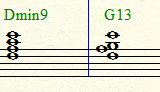

 As our fun with jazz piano chords continues, here we will make reference to a previous lesson that focused on turning a minor 7th chord into a minor 9th chord. Specifically, we will use the same Dmin9 chord voicing for our purpose.
  These are two of the most popularly played jazz piano chords of all time. Again, it’s that one little “switch” that turns the Dmin9 into a G13 chord.
 Let’s take a look at a couple of jazz piano chords that, when played one after the other, make for one of the most popular endings of all time. We will relate this to the key of C Major for our illustration. Of course, as always, you are highly encouraged to transpose what you learn to other keys.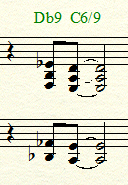
 Any discussion of jazz piano chords much acknowledge this popular chord voicing among the pros. It’s a stock voicing that you’ve got to know. It’s another one of what we call rootless voicings. Many times when a min7 chord is called for, this is one that is used…
 Here we will illustrate one of the most popular jazz piano chords of all time from the perspective of the pros. Yes, it’s another one of those “stock” voicings that you just have to be familiar with. Also, you’ll want to learn this one in all the keys. Not only will you want to but you’ll find it to be one of the easiest jazz piano voicings to execute as well
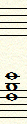 From bottom to top, we have F, B, E. In terms of scale degrees, these are the 7, 3, 13. Play this voicing and listen! Then play the G7 in its basic form above. Go back and forth and compare the sounds of the two. You’re likely to notice that the G13 voicing is quite contemporary in nature. This is due to the fact that it includes a tritone (F to B), a perfect fourth interval (B to E), and a Major 7th interval (F to E). So, there’s quite a bit of dissonance within this chord voicing! (Note that we do not use the 5 in this voicing)