Piano Chord Voicings: The Secret Ingredient
If you have had the pleasure of watching the all time classic
The Wizard of Oz, you will likely recall the beginning of that movie being presented in black and white and, as Dorothy’s dream began, the screen suddenly turned to color.
Piano Chord Voicings: The Facelift Your Songs Are Asking For
That transition from black and white to color brought the movie to life in a way that immediately captured the viewer’s attention. If you were watching, you would have experienced an emotional uplift.
That transition from black and white to color might very well describe the difference between playing basic piano chords and piano chord voicings.
Upon hearing a standard tune performed twice, the first time with basic piano chords & the second with lush chord voicings, the listener might describe it as a “still picture coming to life.”
Understanding Chord Voicings Is Within Your Reach
If you have a handle on playing basic 7th chords and have little or no familiarity with piano chord voicings, you need not worry. You see, you already have the foundation needed to explore this wonderful world of chord voicings.
You are already holding a “painter’s palette,” per se, consisting of the primary colors red, yellow, and blue. Now, imagine that palette consisting of three basic paint colors magically turning into a pallet consisting of hundreds of colors.
That said, don’t think for a moment that you need to know hundreds of voicings in order to put your standard songs across in a much more colorful way. If I had the privilege of sitting by your side I could show you how knowing just two or three voicings could have you performing your standard tunes in a much more professional sounding way. This should serve as encouragement if voicings are new to you.
A Very Tasteful Cocktail Piano Voicing
Let’s take a look at the first chord voicing shared in
ProProach. This voicing works great for cocktail ballads. However, it is not way limited to such use.
Our focus here will be on Major Seventh chords…
A Major Seventh chord can be represented by any one of these chord symbols:
Cmaj7, CM7, CMA7, or C△
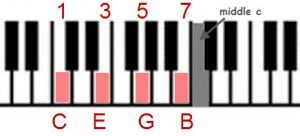
Here is a Cmaj7 chord in it’s most basic, root positions form:
Playing the chord in this way sounds just fine and is often the choice when playing pop tunes. That said, when it comes to playing standard tunes, a jazz player or cocktail pianist will likely opt for a variation of this chord in the form of a chord voicing.
Now, for starters, what is a chord voicing? Well, we can think of a voicing as a chord structure that maintains the essential function of a basic chord that results from manipulating the chord tones in any one or more of a variety of ways.
This could include rearranging the chord tones, doubling one or more of them, eliminating one or more of them, adding more tones, or a combination of any of these.
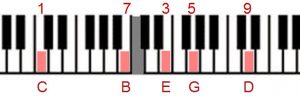
Okay, let’s take this basic Cmaj7 chord structure and create a voicing:
Notice that, for this voicing, we have taken the middle two chord tones – the E and G – and placed them one octave higher. In addition, we have added a tone not included in the basic chord, the D, as the highest note in the voicing. Since the D is the 9, we have here a Cmaj9 chord voicing. We can think of the D as a “color tone” since it really does add some flavor to the basic chord.
Take a moment to play the basic Cmaj7 chord. Then play our Cmaj9 chord voicing. How would you describe the difference? Of course, the way you describe the difference is not nearly as significant as what you experience when you hear it.
Your Approach To Learning Piano Chord Voicings Makes A Difference
When initially learning chord voicings, some individuals simply like to learn a bunch of them and start using them without much consideration. However, a more intuitive learner will compare sounds as we did a moment ago and really consider what contributes to the particular texture of a certain chord voicing.
For example, when we removed the middle two voices (the E and G) and placed them an octave higher, we essentially “opened” the basic chord by leaving a wide interval between the Root (C) and the 7 (B). Spreading the chord tones in this manner makes for a more “open” sound. Adding the 9 (the D) above not only adds color but the fact that this pitch is more than two octaves higher than the Root contributes the this voicing’s “openness.”
Honestly, with all my exposure to materials (books and other), none of them had really described this perspective on chord voicings in any detail. Since I believe that observing voicings this way is conducive to becoming a more creative player, I decided to create such a tool…
Pro Piano Chord Bytes: Secrets To Creating Chord Voicing Magic not only introduces the reader to tasty piano chord voicings but it provides the kind of commentary that leads one to developing a discerning musical ear and discriminating palate when it comes to playing voicings. Even if one doesn’t read music, diagrams are provided.
You will actually be encouraged and inspired to create your own voicings rather than relying on others’ suggestions.
To me, it makes sense to learn about chords with this kind of a mind set. After all, a truly creative pianist will choose such chord voicings based on the texture that they provide. It seems only right that they should be approached that way from the very beginning.
An Enhancement Of Your Vocabulary
Treat your approach to learning piano chord voicings like adding to your personal vocabulary. Learn one voicing. Then find places in your songs where you can it. It’s just like adding a fancy word to your current vocabulary. You may need to transpose that voicing. For example, we just learned a voicing for Cmaj9. However, you will likely find an Fmaj7 chord in a tune that you want to spice up. Simply transpose this chord to an Fmaj9. The more you transpose, the more command you will have!
One Piano Chord Voicing Can Really Be Several
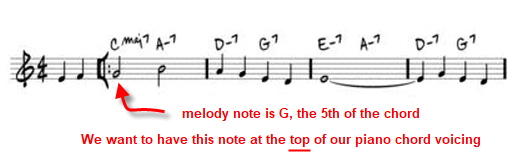
A special lesson of ProProach is devoted to this, but we can touch upon it here. Let’s take another look at the Cmaj9 piano chord voicing above. Now, suppose you are playing a solo rendition of I Could Write A Book by Richard Rogers & Lorenz Hart. That first melody note (after the pickup notes) is a G. This is the 5th of the chord Cmaj7.
Since we want our melody note to stand out, our objective is to keep it at the top of our chord voicing:
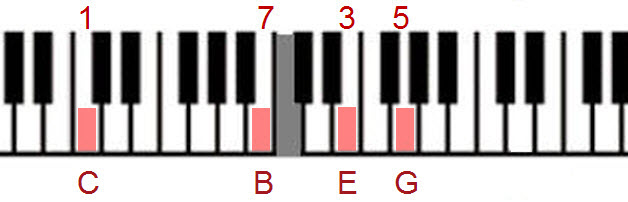
If we simply leave off the 9 of our Cmaj9 voicing above, we are left with a very tasteful way of voicing this melody note! Here it is:
We can take this a step further by still colorizing this chord voicing with that 9 by simply placing it below the 3 of the chord, like this:
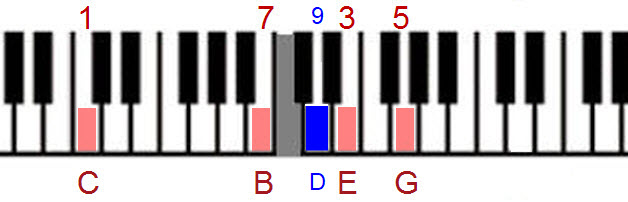
Play this and listen!
Nice!
So, now you have a piano chord voicing that will accommodate a melody note when that note is the 5th of the chord being played. You see, one voicing can take you a long way!
Take It In Stride & Soak Up The Rewards
The real key is to take your time, learn a voicing, and use it. As I always say to my ProProach members, “Overuse it!”
Focus on quality rather than quantity. Your piano chord voicing vocabulary will grow fast enough. Remember, you never had to rush your vocabulary while you were an infant. Little by little, it just happened for you. You are already speaking by playing your favorite tunes. The enhancement of those tunes will happen one voicing at a time!
Enjoy the process : )
Remember,
Always…
ALWAYS…
PLAY WITH PASSION!
Musically,


Voicings are new for me. Reading your material opened my eyes to them👍🎶